


In today’s fast-paced digital landscape, the terms MarTech and AdTech are frequently mentioned across industries—from digital marketing agencies to SaaS startups and Fortune 500 companies. Often associated with artificial intelligence (AI) and data-driven platforms, these two technologies are reshaping how businesses connect with audiences and optimize growth. But what exactly are they—and how do they differ?

What is MarTech? (Marketing Technology)
MarTech, short for Marketing Technology, refers to the collection of tools and platforms that marketers use to plan, execute, analyze their campaigns but is not limited to just these functions. It encompasses a wide range of technologies, including:
- Search Engine Marketing (SEM) & SEO Tools
- Social Media Platforms
- Email Marketing Platforms like SendSorcerer.Pro
- Content Management Systems (CMS)
- Customer Relationship Management (CRM) tools
- Sales Leads Databases like Datain.Cloud
- Business Intelligence and Analytics
- Project Management Tools
- Graphic Design Software
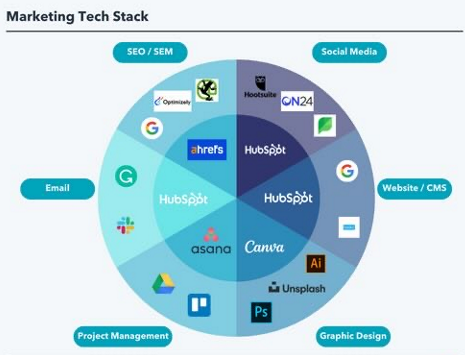
These tools often leverage AI and machine learning to enhance targeting, automate workflows, personalize messaging, and generate insights. However, not all MarTech tools are AI-powered—some simply serve operational or creative functions. MarTech is an essential stack in any digital marketer’s toolbox, enabling smarter, data-driven strategies across customer journeys.

What is AdTech? (Advertising Technology)
AdTech, or Advertising Technology, is a subset of MarTech—but with a more focused role. It powers the programmatic advertising ecosystem, using sophisticated algorithms and machine learning models to facilitate the buying, selling, and placement of digital ads in real time.
Key Components of AdTech include the following:
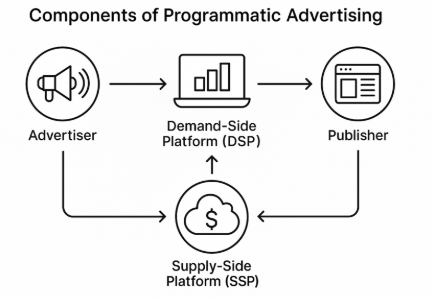
Demand Side Platforms (DSPs)
These platforms enable advertisers to automatically bid on ad inventory based on user data. By aggregating data from multiple sources, DSPs perform identity resolution to classify users into behavioral segments—like “dog lover,” “homeowner,” or “entrepreneur.” These insights inform real-time bidding decisions.
Supply Side Platforms (SSPs)
SSPs work on the publisher side, managing available ad space and optimizing for the highest bidder. The result is an automated auction—known as real-time bidding (RTB)—that determines which ads appear on websites or apps.
Programmatic Advertising Workflow
Through the interplay between DSPs, SSPs, data management platforms (DMPs), and ad exchanges, advertisers reach highly specific audiences across digital channels, maximizing their return on ad spend (ROAS).

MarTech vs AdTech: A Side-by-Side Comparison
| Aspect | MarTech | AdTech |
| Purpose | Manage and optimize marketing strategies | Automate and optimize ad buying/selling |
| Audience | Internal marketers, agencies, and business teams | Advertisers and publishers |
| Examples | CRM, Email platforms, Analytics tools | DSPs, SSPs, Ad Exchanges |
| AI/ML Use | Optional, often used for personalization/insights | Essential for real-time bidding and targeting |
| Scope | Broad: campaign management, analytics, automation | Narrow: advertising performance and delivery |

Why It Matters for Digital Marketing Agencies
For digital marketing agencies, understanding the difference between MarTech and AdTech is crucial. While MarTech helps with campaign strategy, customer engagement, and lead nurturing, AdTech enables automated media buying that places ads in front of the right people at the right time.
Combining both effectively can elevate an agency’s ability to generate sales leads, deliver targeted campaigns, and improve ROI for clients.

Final Thoughts
In an era where AI, machine learning, and data-driven marketing are the norm, understanding both MarTech and AdTech is no longer optional—it’s essential. Whether you’re building email marketing automation with tools like SendSorcerer.Pro or launching precise programmatic campaigns via a DSP, understanding the differences and strengths of each technology gives your business a competitive edge.




Leave a Reply